

Choosing the Right Residential Security Camera System for Your Home
Introduction
Home security technology has advanced considerably in recent years. Homeowners now have access to camera systems that were previously available only to commercial operations. High-definition video, infrared night vision, remote viewing, cloud storage, and motion-triggered alerts are standard features across a wide range of products designed for residential use.
Despite the availability of better technology, many homeowners select a residential security camera system without a clear framework for evaluating their options. The result is often a system that looks adequate in the packaging but leaves meaningful gaps in coverage, fails to perform in low-light conditions, or requires replacement within a few years because the hardware was not built for long-term outdoor use.
This article outlines the primary factors homeowners should evaluate when selecting a residential security camera system, including camera types, placement strategy, storage options, and the differences between residential and commercial-grade products.
Understanding the Purpose of a Residential Security Camera System
Deterrence and Detection
A residential security camera system serves two distinct functions. The first is deterrence. Visible cameras at entry points signal to potential intruders that the property is monitored. Research consistently shows that properties with visible surveillance are less likely to be targeted than those without.
The second function is detection and documentation. When an incident does occur, the system needs to capture footage that is clear enough to be useful. That means readable faces, identifiable vehicles, and a timestamp that establishes a sequence of events. A system that deters but cannot document is only partially effective.
Common Use Cases for Homeowners
Homeowners install residential security camera systems for a range of reasons beyond general security. Package theft from front porches has become a widespread concern in residential neighborhoods across the United States. Monitoring children or elderly family members who are home during the day, verifying that a service provider completed work on the property, and documenting damage from weather events or neighboring construction are all situations where a home camera system provides practical value beyond traditional security purposes.
Camera Types Used in Residential Systems
Dome Cameras
Dome cameras are enclosed in a rounded housing that is typically mounted on a ceiling or overhang. The dome shape makes the direction the camera is pointing less obvious, which can be an advantage in applications where a discreet appearance is preferred. Dome cameras are commonly used at covered entry points, garages, and carports where the housing is protected from direct weather exposure.
Turret Cameras
Turret cameras use a ball-and-socket design that allows the camera to be repositioned within its mount without removing the hardware from the wall or ceiling. The lens in a turret camera is not enclosed behind a glass dome cover, which eliminates the infrared reflection that can reduce image quality in dome cameras during nighttime recording. Turret cameras are frequently used at front and rear entry points, driveways, and side gates.
Bullet Cameras
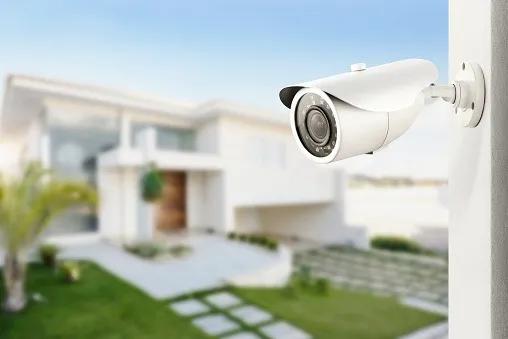
Bullet cameras are enclosed in a cylindrical housing and are typically used for longer-distance coverage. They are well-suited for driveways, streets, and outdoor zones where the camera needs to reach further into a scene than a dome or turret can manage. The visible, directional profile of a bullet camera also serves as a clear visual deterrent.
Wireless and Battery-Powered Cameras
Wireless cameras transmit footage over Wi-Fi and may be powered by a rechargeable battery, a solar panel, or both. They can be installed in locations where running power cables is impractical. Performance depends on the strength of the Wi-Fi signal at the installation point and the battery capacity relative to the camera's usage patterns.
Outdoor Placement and Home Surveillance Cameras: Outdoor Considerations
Entry and Exit Points
The front door is the most common entry point for residential break-ins and the location most homeowners prioritize when planning home surveillance cameras outdoors. Rear doors, side gates, and basement entrances are secondary entry points that should also be covered in a complete system.
Camera height and angle at entry points determine whether the footage captures a usable image of a person's face. A camera mounted too high captures the top of a person's head rather than their face. An installer or experienced system designer will specify a mounting height that produces useful footage for the specific entry configuration.
Driveway and Vehicle Coverage
A camera positioned to cover the driveway captures vehicle approach and departure. If the camera is close enough and angled correctly, it may also capture license plate information from vehicles that stop at or near the property. For homeowners who want consistent plate capture, a dedicated license plate camera at the driveway entrance provides more reliable results than a general surveillance camera.
Perimeter Zones
Side yards, back yards, detached garages, and exterior gates represent zones that are less visible from the street and therefore more attractive to someone attempting to access the property undetected. Home surveillance cameras outdoors at these locations extend coverage beyond the primary entry points and reduce blind spots that an intruder might otherwise exploit.
Lighting Conditions and Night Vision
Most residential outdoor cameras include infrared night vision. The effective range of infrared illumination varies by model. A camera rated for effective night vision at 30 feet performs differently from one rated for 60 feet, and the difference matters when the camera is covering a long driveway or a backyard with significant depth.
Properties with existing landscape or security lighting may benefit from color night vision cameras, which use ambient light rather than infrared illumination to produce footage in visible color rather than black and white. The tradeoff is that color night vision requires some level of ambient light to function, which infrared systems do not.
Residential vs. Commercial Security Cameras
Build Standards
Commercial security cameras are built to withstand heavier use, higher environmental stress, and longer operational cycles than most residential products. The housings are typically constructed from more durable materials, the sensors are designed for more demanding conditions, and the components are rated for longer service life.
Some homeowners, particularly those in areas with extreme heat, high humidity, or significant temperature variation, find that commercial security cameras installed at exterior locations perform more consistently over time than residential-grade products. Central Texas, for example, subjects outdoor cameras to sustained high temperatures during the summer months that can shorten the operational life of hardware not designed for that environment.
Feature Differences
Commercial security cameras typically offer higher resolution, broader dynamic range processing, more sophisticated motion analytics, and integration with enterprise recording platforms. These features are relevant for homeowners who want performance that exceeds standard residential specifications or who plan to integrate their home system with cameras at a business property they also manage.
When Commercial Grade Makes Sense for Residential Use
A homeowner managing a property with a large outdoor footprint, multiple detached structures, or a combination of residential and small business use may find that a residential security camera system built on commercial-grade hardware serves their needs more reliably over time. The decision depends on the scope of coverage required, the environmental conditions at the property, and the intended operational life of the system.
Storage and Recording Options
Local Storage with NVR or DVR
A network video recorder stores footage from IP cameras over the local network. A digital video recorder serves a similar function for analog camera systems. Local storage does not depend on internet connectivity and allows for high-capacity retention of continuous or event-triggered footage. The primary limitation is that a damaged or stolen recorder results in the loss of stored footage.
Cloud-Based Storage
Cloud storage transmits footage to an off-site server, where it is accessible from any device with an internet connection. Off-site storage protects footage from on-site theft or equipment damage. Cloud storage typically involves a subscription for ongoing access and is limited in continuous retention capacity compared to a large local drive.
Hybrid Systems
Many residential security camera system installations combine local and cloud storage. The system records continuously to a local NVR while transmitting motion-triggered clips to the cloud. This approach provides both high-capacity local retention and off-site backup for critical events.
Professional Installation Considerations
A professionally installed residential security camera system produces more reliable results than a self-installed consumer kit in most cases. Professional installation includes a site assessment, camera selection matched to the specific environment, clean cabling, correct mounting at heights and angles that produce usable footage, and configuration of recording schedules, motion zones, and alert settings.
Post-installation support is another factor. A professional installer who remains available for troubleshooting, expansion, and camera repositioning as the homeowner's needs change provides value beyond the initial setup.
Provider Considerations in Central Texas
Homeowners across the Austin, Round Rock, and Killeen areas have access to local providers offering full-service residential camera system design and installation. Centex Security Cameras, operating as CTVCAM, serves residential and commercial clients throughout Central Texas with camera packages that include turret, dome, bullet, and specialty options. The company handles site assessment, camera system installation, recording configuration, and ongoing support for homeowners seeking a professionally installed residential security camera system tailored to their specific property.
Homeowners evaluating providers should verify licensing credentials, review the provider's experience with residential installations, and confirm that post-installation support is included as part of the service.
Conclusion
Selecting a residential security camera system involves evaluating camera types, outdoor placement strategy, storage configuration, and whether residential-grade or commercial-grade hardware is appropriate for the property's environment and coverage requirements. Homeowners who approach this decision with a clear framework are more likely to end up with a system that performs consistently over time and delivers usable footage when it is needed.
Professional installation, proper site assessment, and ongoing support from a qualified provider are factors that contribute significantly to system effectiveness beyond the hardware itself.